We have measured magnetic fields evoked by the onset of checkerboard-like sectorial patterns presented at 16 locations near the center of the visual field. Small stimuli (less than 2 degrees), which, nevertheless, gave sufficiently strong responses to enable source localization, were used to limit cortical activation to a small area, thus simplifying the analysis of the magnetic field data.
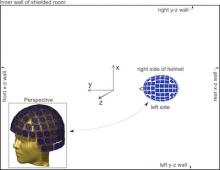
Current MEG instruments derive the whole-head coverage by utilizing a helmet-shaped opening at the bottom of the dewar. These helmets, however, are quite a bit larger than most people's heads so subjects commonly lean against the back wall of the helmet in order to maintain a steady position. In such cases the anterior brain sources may be too distant to be picked up by the sensors reliably. Potential "invisibility" of the frontal and anterior temporal sources may be particularly troublesome for the studies of cognition and language, as they are subserved significantly by these areas.
We report an 11-year-old boy with intractable epilepsy, who had cortical dysplasia in the right superior frontal gyrus. Spatiotemporal source analysis of MEG and EEG spikes demonstrated a similar time course of spike propagation from the superior to inferior frontal gyri, as observed on intracranial EEG. The tractography reconstructed from DTI showed a fiber connection between these areas. Our multimodal approach demonstrates spike propagation and a white matter tract guiding the propagation.
BACKGROUND AND PURPOSE: Determination of hemispheric language dominance is critical for planning epilepsy surgery. We assess the usefulness of spatiotemporal source analysis of magnetoencephalography for determining language laterality.
INTRODUCTION: Tuberous sclerosis complex (TSC) is a multisystem genetic disorder affecting multiple organs, including the brain, and very often associated with epileptic activity. Language acquisition and development seems to be altered in a significant proportion of patients with TSC. In the present study, we used magnetoencephalography (MEG) to investigate spatiotemporal cerebral language processing in subjects with TSC and epilepsy during a reading semantic decision task, compared to healthy control participants.
We propose INvariance of Noise (INN) space as a novel method for source localization of magnetoencephalography (MEG) data. The method is based on the fact that modulations of source strengths across time change the energy in signal subspace but leave the noise subspace invariant. We compare INN with classical MUSIC, RAP-MUSIC, and beamformer approaches using simulated data while varying signal-to-noise ratios as well as distance and temporal correlation between two sources. We also demonstrate the utility of INN with actual auditory evoked MEG responses in eight subjects.
OBJECTIVE: To evaluate the sensitivity of a simultaneous whole-head 306-channel magnetoencephalography (MEG)/70-electrode EEG recording to detect interictal epileptiform activity (IED) in a prospective, consecutive cohort of patients with medically refractory epilepsy that were considered candidates for epilepsy surgery.